Demystifying AI
Ryan Van Cleave - April 2026
Artificial intelligence has rapidly moved from a niche technological concept to a dominant force shaping modern life. Headlines alternately promise revolutionary breakthroughs or warn of existential threats, often portraying AI as something mysterious, autonomous, or even sentient. This framing obscures a more grounded reality, where limitations and risks are often overshadowed by the promise of capability. My concern lies in something much more immediate: how AI is reshaping the way we think, learn, and solve problems.
While AI is an undeniably powerful tool, it can also replace the very processes that lead to personal growth. The more we get used to relying on it, the harder it becomes to step back and rebuild that relationship with intention. My hope is to provide some information to help you become a more critical consumer, and to encourage you to evaluate the role you allow it to play in your life.
This document is divied up into collapsible sections. Feel free to skim, or click into a section for a deeper dive.
How AI Works
At their core, AI systems are mathematical processes, not thinking entities. This becomes clear when examining the different types of AI systems in use today. Let’s take a look at how a few of the most popular AI models operate.
Large Language Models (LLMs)
These AI are focused on generating plausible text. Given a prompt, they are trained to find the next most likely word. By repeating this process iteratively, an LLM is able to piece together a full written response that sounds natural. Given that one word is generated at a time, the model does not know what the full response will be, and does not fact-check its statements. This leads to text that sounds confident, but isn’t necessarily correct - just likely to sound right based on the patterns in the training data.
Training
Part of a real sentence is provided, with a word missing. The model is trained to make a guess at what the most likely word is, then shown the real answer, and the model is updated so it’s more likely to guess correctly in the future. This process is repeated billions of times across massive datasets.
Computational Mechanisms
- When a user inputs a prompt, it is first broken down into smaller units called tokens. For the sake of explanation, we’ll assume that each word is a separate token, but in reality tokens can be fragments of words. Each token is pre-assigned a numerical value in the model’s dataset.
- These tokens are then converted into multidimensional vectors, where the values of each dimension encode meaning and usage into the token. These dimensions are known as parameters, and they can help describe things like the tone of the word, whether it’s big or small, if it’s colorful, etc. Words that are related to each other will have parameters of similar values. GPT-4 has 1.7 trillion parameters.
-
These vectors are processed through layers of transformations using mechanisms known as attention and feed-forward networks. This process allows the model to adjust the values of the parameters for each token based on all of the other tokens. This is what allows the AI to determine the context of how each word is used. In this example, the presence of the token “AI” updates the values of the token “model” from describing a fashion model to describing an AI model.
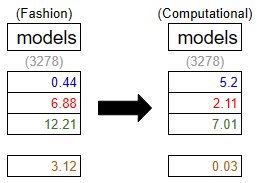 This refinement process is repeated many times, gradually building a more contextually accurate representation of the input. GPT-4 is a 120 layer model, so this process is repeated 120 times. This number is relatively arbitrary - more layers improve the quality of the output, but with the payoff of a higher cost of compute.
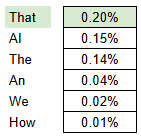
- Now that the data is contextualized, the model presents a probability for what the most likely next token will be, and a token is selected from the list. Up until this point, the process is repeatable with exacting results. Given the same prompt, the model will come to this deterministic state, with the exact same next-token probabilities.
- Next, a token is selected from the list. The token that is chosen isn’t always the most-likely token. If it was, the AI would produce consistent, and pretty boring results. A tuning mechanism known as temperature determines how likely the model is to deviate from choosing the top result. This is why the same prompt will produce varied responses.
- The selected token is appended to the text, and the process repeats until either an end of response token is generated, or a compute limit is reached.


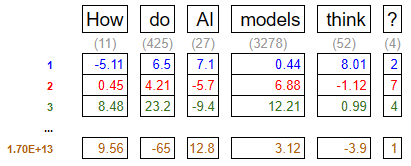


While the results can feel conversational and coherent, the underlying mechanism is fundamentally a sophisticated form of pattern completion. In essence, LLMs are highly advanced word-guessing systems.
Image and Video Generation Models
These AI specialize in generating images from text. They are trained to take a set of randomized pixels, and treat it as a very blurry image. The processes involved allow the model to ‘unblur’ the image in a way that matches the desired target from the prompt.
Training
Two goals must be accomplished for an image generator to function. The model must learn to render images, and it must internalize the relationship between text and images in a way that allows it to generate a relevant image when prompted.
Computational Mechanisms
To begin training, a massive dataset of images with text descriptions is collected - this includes captions, tags, and metadata. For current models, this is essentially the entire content of the internet. (more on this later)
Goal 1 - Predict Images
- An image is chosen from the dataset, and noise is gradually added to it until it becomes pure noise. This process is called forward diffusion, and it’s repeated a few billion times.
- The model is then shown a noisy image and a corresponding text prompt. It’s trained to predict the total noise that was added, and attempt to reconstruct the original image.

Goal 2 - Encode Text-Image Relationships
- Just like the LLM training, images can be broken up into parts and analyzed for patterns that provide context. In this case, tokens are pixels rather than (parts of) words. The color values of the pixels help inform the parameter values of the image, just as the words in the sentence help inform the parameter values of a sentence. A sentence beginning with the words “Once upon a time…” is very likely the beginning of a story. An image where the first four pixels are blue might be likely to depict a blue sky.
- The dataset is arranged in a massive table, such that the images are on one axis, and the corresponding captions are on another. At this point, the data used for the images is random. Through training, it will be adjusted to usable values.
- The diagonal of this table contains matching image-caption pairs. To correctly encode the context of the images, the model adjusts the image data so that it maximizes the similarities of the values along the diagonal, while minimizing the similarities elsewhere.
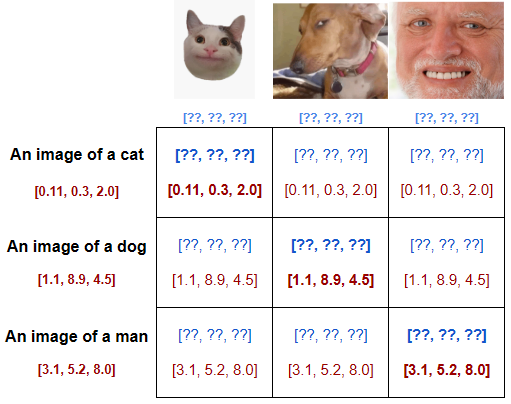
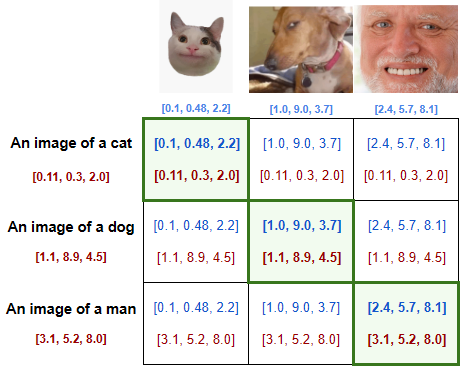
With the combination of these goals accomplished, the model is able to infer what sort of image best matches the prompt being requested. It starts with random noise, and denoises the image in a way that matches the desired prompt.
Interestingly, generating an image is less computationally intensive than generating a text response, as the model does not need to iteratively add on one pixel at a time, in the way that it does with text.
Extractive AI
These AI are focused on retrieval rather than synthesis.The underlying context data is similar to that of an LLM, but responses are provided as excerpts rather than a generated string of text. These systems are quietly doing some important work in document analysis, where they can flag or extract from massive datasets for audits.
Specialized AI (Domain-Specific AI)
Specialized, narrow tools designed to meet specific needs - often for research or processes that benefit from pattern recognition. Being proprietary systems, they’re often a blend of techniques from the other AI forms, with datasets and training that is specific to their domain. A medical diagnostic tool that requires accuracy has a very different set of needs from a general AI that isn’t held to a similar standard.
Risks
Despite these limitations, AI systems offer meaningful strengths. They excel at recognizing patterns across large datasets, transforming information into different formats, and compressing complex knowledge into more accessible forms. However, these strengths must be weighed against their weaknesses, particularly when deployed at scale.
The risks associated with AI are difficult to quantify, in part due to limited transparency from the companies developing these systems. Clashing incentives further complicate the issue - some parties benefit from overstating AI’s capabilities while others overstate its environmental or social impacts. It can be hard to know exactly what to believe. Here are the risk factors that I believe are worthy of consideration.
Energy Usage
Do your best to limit your personal footprint while recognizing that this is mainly a systemic issue.
Training large AI models requires significant computational resources, and running them at scale, known as inference, adds ongoing energy demands. The extent of this impact is difficult to measure accurately, as companies do not freely release this data. The best estimates come from concerted efforts to analyze and extrapolate data from smaller open-source models and hardware capabilities. Energy-per-prompt sounds like a straightforward metric for tracking the cost of inference, but it unfortunately breaks down quickly. Unknowable factors like the location of the data center processing the request, the time of day in that area, and number of concurrent requests from other users can cause the energy use to wildly fluctuate. Some prompts even require multiple subsequent prompts within the LLM to generate a response.
How Much Does a Prompt Cost
Here are some current estimates for energy consumption.
- Per Google Search: ~1080 joules
- Per Image Generated: ~2282 - 4402 joules
- Per Text Response: ~6706 joules
- Per Video: ~109,000 joules for a low-quality short output; ~3.4 million joules for a higher-quality 5-second video.
Note: It takes ~600 joules to run a microwave for 1 second.
If these estimates are accurate, the cost of inference is lower than one might expect for the amount of concern being raised around energy consumption. After all, the +30s button is likely the most used button on a microwave, and nobody gives it a second thought. As a consumer, your individual prompts are likely not the root of concern for energy use, however there are some caveats that validate these concerns.
- The energy used by data centers is carbon-intensive - 48% higher than the US average.
- Data centers rely on potable water for their cooling systems, and expansions of these facilities can strain local water budgets.
- The scale at which AI is being integrated into software products is massive. Opening an email generates a summary and a reply. Performing a Google search now prompts a Gemini prompt. Simple tasks are being compounded with additional energy costs, and this does add up at scale.
While the individual footprint may be small, it is built on top of existing energy demands, and the scale of the implementation is substantial. Estimates vary widely, and the lack of standardized reporting makes it difficult for consumers or policymakers to make informed decisions. As a result, these technologies are being adopted and expanded without a reliable understanding of their true environmental cost.
Slop
Reputable information is getting harder to verify, so it's going to take more effort to stay well-informed.
AI-generated content is contributing to what some describe as a fragile information ecosystem. The rapid production of low-quality or misleading content (slop) blurs the line between authentic and generated material. This not only makes it harder to discern truth, but also creates feedback loops - where AI-generated content is used to train future models, potentially amplifying inaccuracies over time. These dynamics raise concerns about a “dead internet,” where human-generated content becomes increasingly diluted. Humans currently account for only 49% of internet traffic. With the rise of slop, consumers have a growing responsibility to regulate and validate their sources of truth.
AI in Education
Recognize the cost of cognitive offloading.
In the classroom, AI tools present both opportunities and challenges. While they can support learning, over-reliance may hinder the development of critical thinking and problem-solving skills. An increasing readiness to offload cognitive work, and the ease of generating answers contributes to academic dishonesty, undermining the value of assessments and credentials. Advancement and deployment of the technology is outpacing educators’ ability to adapt their curriculum to it.
AI Art
There are some concerning ethics with current generative AI models.
Creative professionals face additional pressures, as generative tools can replicate styles and produce content at scale, often trained on copyrighted works without consent, credit, or compensation. Models can be trained to produce art in specific personal styles, and often have the artist’s name attached, again without their consent. This isn't limited to established artists either. As Steven Zapata puts it in his TEDx Talk, “I get messages from [the students] every day… they worry that they’re going to teach an AI system their style before they’ve had a chance to do anything good with it in the first place.” This raises questions not only about the economic impact of but also about the erosion of creative confidence and identity. The optics of using AI generated content in professional settings are already trending negatively, but there is a cost with engaging and supporting such systems even for personal use. There may come a future where AI art is indistinguishable from human art, but it is not a future I’m personally striving for.
Recommendations
Given these realities, a more intentional approach to AI use is necessary. As society adapts to the growing presence of these tools, it is a responsibility of each of us as individuals to govern our relationships with them. Here are my recommendations:
- Limit your usage, and be intentional. Avoid habitual or passive reliance. Utilize Google search instead of prompting an LLM, and click into links to validate claims and context from the Gemini summary. Consider adding the ‘-ai’ tag to your search to forego the AI summary and filter out AI generated results.
- Stay skeptical of bold claims. Narratives about imminent artificial general intelligence or total job replacement often reflect underlying incentives, whether financial, political, or reputational. Understanding these motivations helps contextualize the messaging and avoid overreaction.
- Prioritize Self-Empowerment. Maintain core skills like writing, problem solving, and critical thinking. Use AI as a tool, not a crutch or a replacement for the effort. Maintain friction where friction builds skill.
What the Future Holds
Looking ahead, AI is unlikely to disappear, but its current trajectory is likely unsustainable. While larger models have driven recent advances, the benefits of increased scale are beginning to diminish relative to their cost. I believe we’ll see a shift toward smaller, more specialized models that can run locally - offering greater transparency, efficiency, and user control. These systems may achieve much of the same functionality while avoiding some of the drawbacks associated with massive centralized models.
The most significant long-term risks of AI may not come from dramatic, science-fiction scenarios, but from gradual shifts in how people interact with information and each other. Increased mistrust, cognitive dependence, and social fragmentation are more plausible outcomes than sudden technological takeover.
AI is not magic, nor is it sentient. It is a powerful tool, but only when used in ways that align with its strengths and limitations. By understanding how it works, acknowledging its risks, and making deliberate choices about its use, we can engage with AI in a way that preserves both its benefits and our own independence.
Further Watching/Reading
In the process of writing this paper, I made a significant algorithmic sacrifice. I consumed an unrecommended amount of information regarding AI technology, and it is now salient in my content feeds. Some of it was fantastic, and a lot of it was not. Here are some sources that I think are worth checking out.
Better Explanations than Mine
Large Language Models Explained Briefly by 3Blue1Brown
How LLMs Actually Generate Text by LearnThatStack
But how do AI images and videos actually work? by Welch Labs
The problem with AI-generated art | Steven Zapata | TEDxBerkeley by TEDx Talks
AI Slop Is Destroying The Internet by Kurzgesagt - In a Nutshell
Energy Consumption Data
Hugging Face is one of the organizations involved in developing open source models, and is in the process of developing standardized energy usage metrics. These currently apply to their open source models, but may one day be adopted for larger models.
Here is a conglomeration of many sources of data on AI energy consumption.